
Re-Imagining Leadership Development
I’m critical of leadership development programmes – despite the fact Vibrant has spent over a decade offering leadership solutions.
It’s not that I don’t enjoy them.
Across ‘25 / ’26 alone I will have facilitated programmes for thousands of leaders of all levels, spoken at conferences across Europe and we have clients in the UK, Ireland, all over Europe, North and South America.
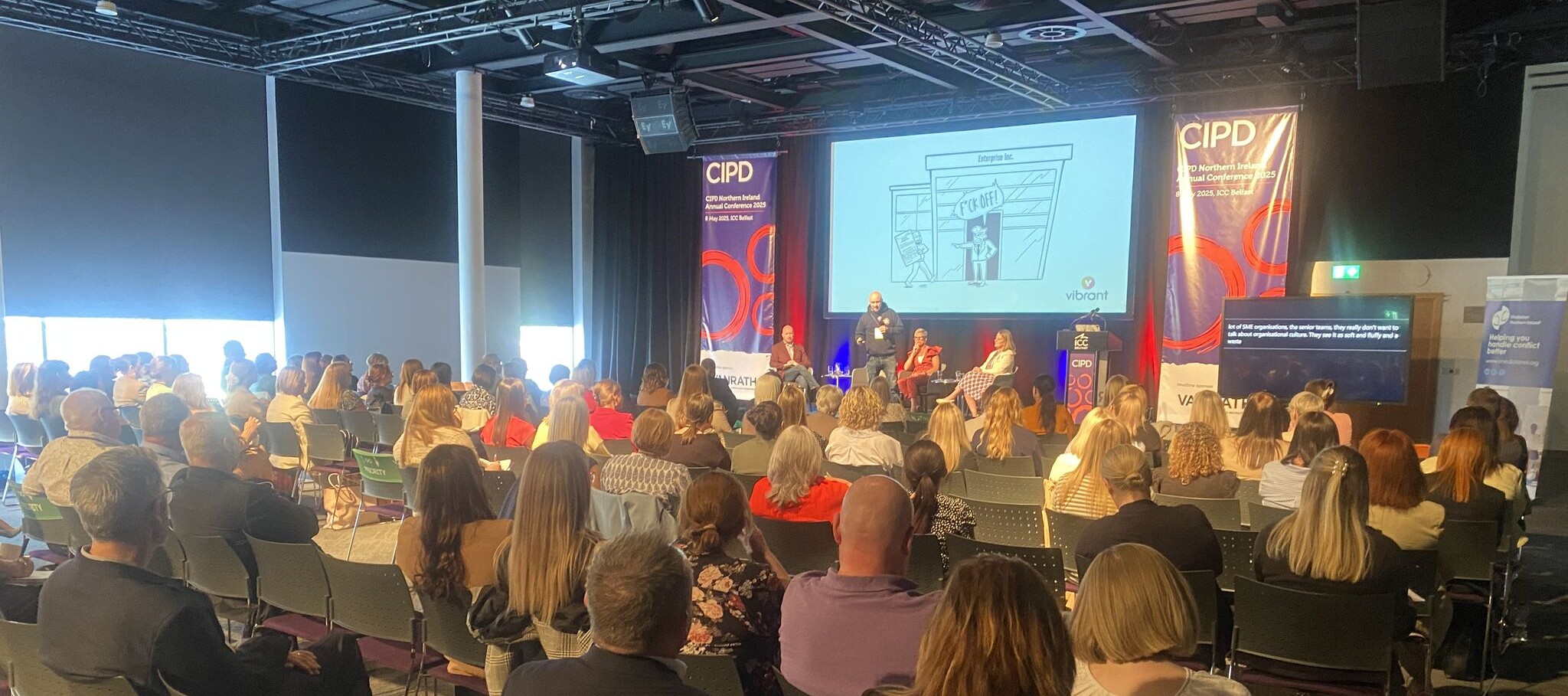
The experience is always enriching, and I wouldn’t keep doing it if I didn’t enjoy it and see value for those I work with.
But I have many doubts about what leadership programmes really achieve.
Companies and cultures do not change on leadership programmes.
Individuals may evolve – but the system, the structure, the processes and the policies they operate within remain the same.
The result is often that the problems the business is facing which dictated the decision to invest in leadership development (inability to fill vacancies, attendance, performance, and staff retention issues) remain despite a significant financial outlay.
The problem is not usually the quality of the programme, it’s that often the programme itself is not the right solution for the challenges the business is facing.
Managers get frustrated when they’re repeatedly sent on theoretical leadership courses when they’ve heard the content before. They know in theory what it means to lead, what they need is the opportunity to put it into practice by addressing the real issues in the company.
Even then, they can’t do it alone.
The culture of a business is created by everybody – so it doesn’t change by working on less than 10% of the workforce (the formal leaders – and only those on the leadership programme).
A leadership programme does not work on the business; it works on the managers in isolation from the business.
Sure, there can be business improvement projects tied in.
But they’re often cherry picked and usually token projects on the side of a day-job for those ‘on a course’ – a distraction they don’t want or need, and something they’re only doing for the sake of the programme.
As soon as the programme is over, everything defaults back to its natural state.
The participants’ hearts and souls are not in it – even if they enjoy the course – they see ‘homework’ as a burden, when they’re already too busy…
These projects are also often not what really needs attention in the company, and what does need attention – is not a job for one or two people in isolation from their teams.
That’s why we launched the Vibrant Workplace Accelerator, because sometimes it’s not the managers but the company or collective culture that needs to change.
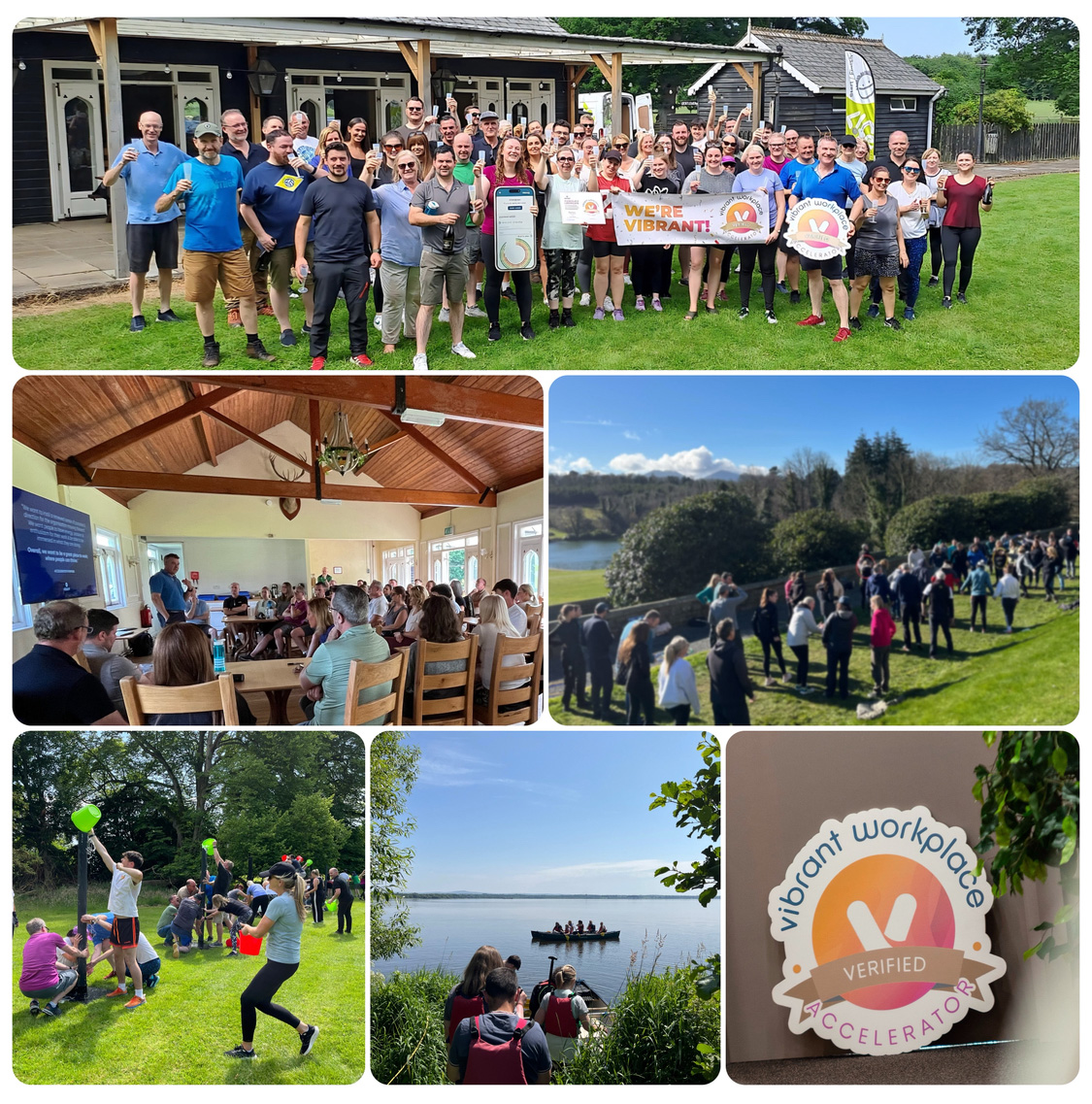
The Accelerator is leadership development, in the real world, for every single employee, working together to improve how business happens.
That said, without doubt, formal leadership programmes combining training and coaching are still a useful intervention.
Leadership development programmes are an ingredient in the recipe of a Vibrant Workplace; they’re just not the whole recipe.
As the 70:20:10 learning model suggests:
- 70% of learning happens in the real world
- 20% through coaching and mentoring
- 10% in the classroom
Now, that’s not to say we should just throw those in positions of responsibility in at the deep end and have them sink or swim learning on the job.
Quite the opposite.
They’ll develop coping mechanisms, bad habits that get them through, hate the job and their teams will hate them.
Gallup report that roughly 70% of team engagement is determined by the quality of relationship between a line manager and their employees
The quality of the learning during the 10% and the 20% lay the foundations, creating a platform from which people can flourish.
So now that we’ve given it its place, let’s get on to how we actually develop leaders.
Because I think leadership development has some major problems.
I’m going to talk here about only three for the sake of the length of this article…
But I think it’s time to re-imagine a better way to develop leaders.
3 Common Problems with Leadership Development
Problem 1: It starts too late, costing the business, the team and the employee…
We all say leadership is not a job title, and that we want leaders throughout our teams. Yet when it comes to formal leadership development that’s something we only offer to those already in positions of authority.
We probably formally develop leadership capability within about 10% or less of the workforce.
And this is a problem.
People don’t know if they’re going to enjoy leading others until they move into the role. Either they choose to do so because they want more money and that’s the way to get it, or they’re encouraged to because they’re good at what they do.
Very few people know what it will be like to be a leader until they’re on that journey.
And then, it’s sink or swim…
The Chartered Management Institute indicate that 82% of people entering management positions are ‘accidental managers’ who have had no formal training…
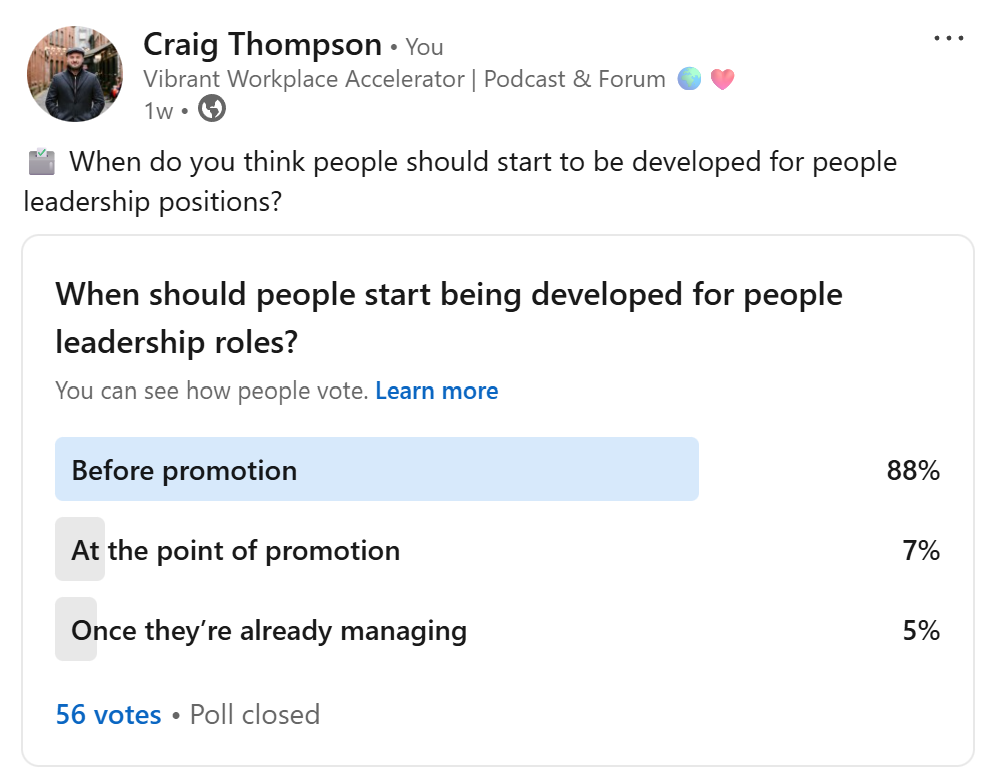
When I polled my network recently to see when they think people should start being developed for this type of work – the overwhelming consensus was before promotion…
Often what happens is we take our most operationally excellent people and funnel them into positions of responsibility hoping it works. After all, they’re good at what they do – surely they can magically make those around them become just like them?
But leadership is a different job.
And what made them operationally brilliant, won’t necessarily mean they can influence, motivate and transform those around them to become the same.
It’s a different skillset.
That doesn’t mean it’s bad to have operational / technical knowledge or expertise in a leadership role. Ideally, we would have leaders who have that AND the ability to lead.
But those ‘soft skills,’ which ironically are often the hard skills, are imperative.
All too often these people go from being the most engaged, high-performers in operational roles, thriving at work – to the most disengaged underperformers – but it goes unnoticed because their new role is hard to quantify.
The success of a leader is not how well they perform as an individual, it’s their ability to create an environment in which those in their care thrive.
And so, the performance of the team becomes the measure of their success.
Probably the complaint I hear the most often in coaching is from people who hate that they can’t quantify their own success anymore after promotion.
They need to understand that their success is the success of those around them.
It’s not about doing the work of their team – which is the trap most fall into.
If that was the case, they would just be senior team members.
Their position is now one of service.
They’re enablers for want of a better expression.
And some HATE that.
They don’t like the thought that they can’t come to work, do XYZ and know they’re performing for hitting productivity targets.
People come to them with people problems – and they’re not comfortable.
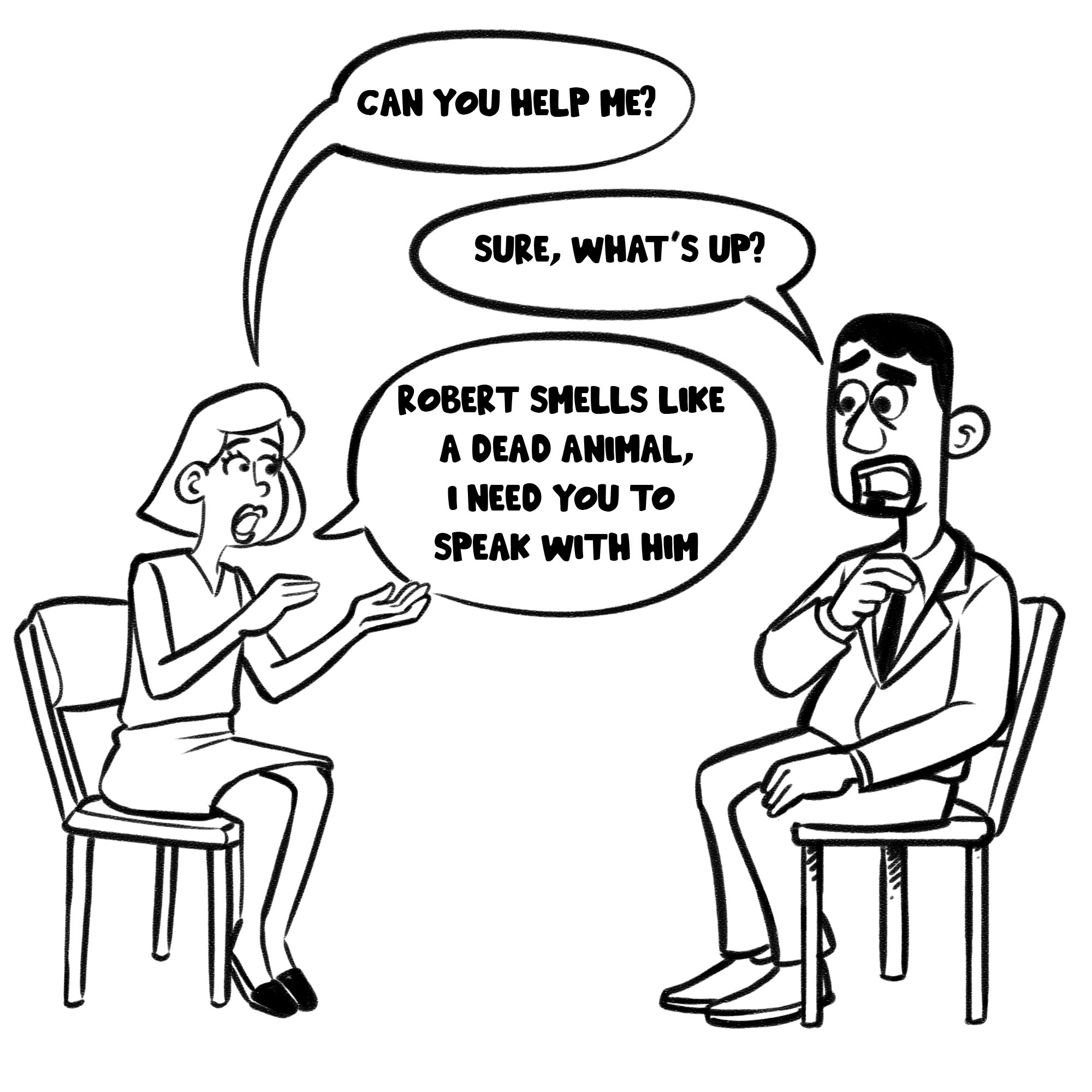
That’s not what they enjoy, and those are not the type of problems they want to spend their day resolving.
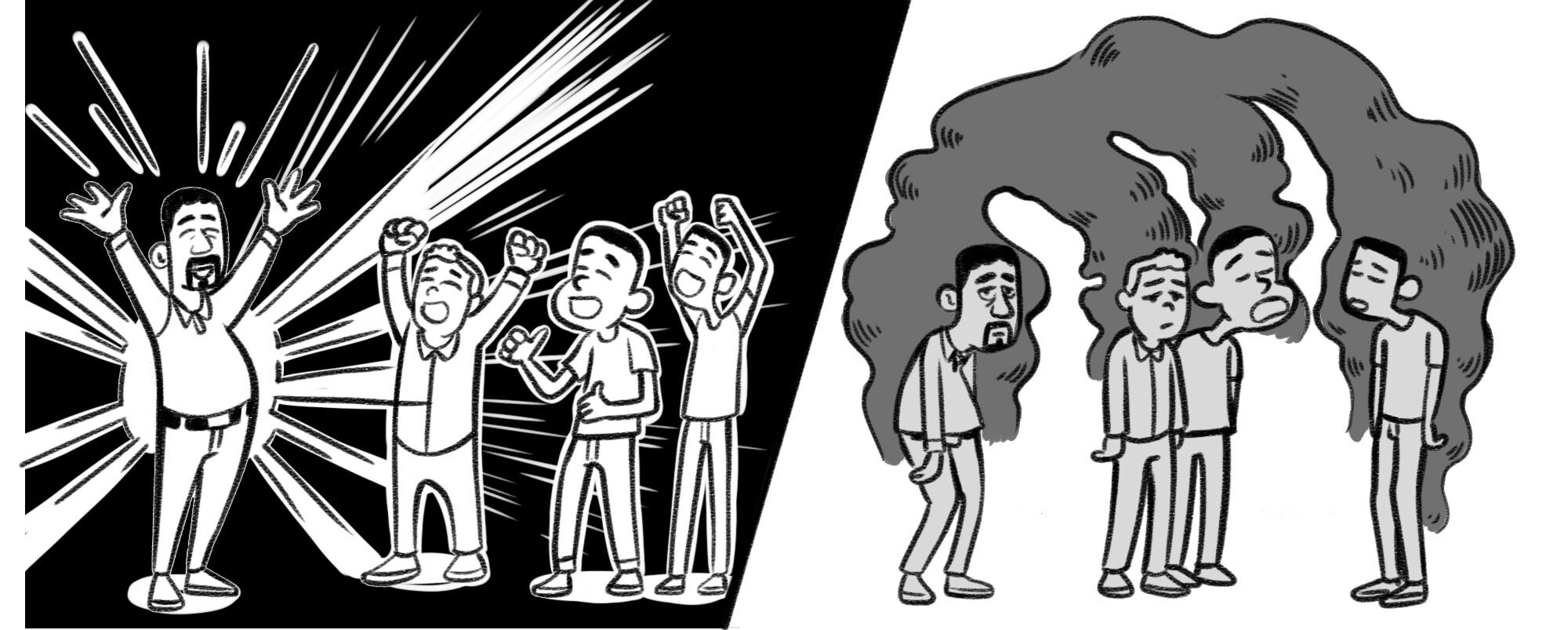
The former high performer is now struggling in their new role, and how they bring themselves to work and the way they do their job impacts everybody.
Because in this role, they’re an amplifier – and they will either amplify engagement, or disengagement right throughout their team.
The company really needed to know if people leadership was the right route for this person before they promoted them.
The person themselves needed an opportunity to test the water and get a feel for what people leadership is really all about before they changed the direction of their career.
Now, they’re stuck in a job they’re unhappy in, they feel they can’t go back, and they’re failing in a role that’s not right for them – which is affecting everybody.
Approximately 60% of new managers fail within the first 24 months due to inadequate preparation.
What happens next?
They either quit, or they’re ‘relieved…’
What a sad end to what was previously a bright career.

Some companies have copped on; there needs to be development pathways for people who still need advancement but aren’t right for leading a team.
Individual, but still talented and important, contributors.
This still doesn’t address the issue of who should lead our teams though.
It doesn’t give anyone exposure to people leadership for who it might be great.
And it doesn’t show a company whether someone has potential before they commit to a promotion that may cause years of pain for the individual, the team and the company.
65% of Americans polled said they would take a new boss over a pay raise…
Problem 2: Everyone has a leadership qualification, but very few actually lead…
You know this.
I’m going to be unpopular for saying it.
But the fact is – just like with employer recognition certifications – everyone who goes on a leadership qualification gets the badge.
That’s not setting a standard, that’s a participation trophy.
And it’s harmful. I’ve seen it first-hand.
Personally, I’m tired of running programmes and seeing the fire in some people – the passion, the ideas, the inspiration to lead – the desire to try new things, the determination to be proactive, put things into practice, learn and evolve…
…while someone else shows up and drags their heels from start to finish – if they show up at all, frankly.
They skip half the course, show no willingness to engage, no curiosity.
For some, they’ve nothing left to learn, which gobsmacks me…
I go into every engagement with anyone at any level knowing there’s something I can learn. As a species we are always getting new information and evolving.
What we believed great leadership to be 30 years ago is very different to today and it will be different in the future too.
We need to be humble, and ready to learn from every situation.
Because the context is always changing. And the workforce is always changing.
The only way to lead effectively in a rapidly changing world is to constantly keep an open mind and have a willingness to be wrong, a willingness to learn.
A growth mindset is not hearsay.
According to research by Liz Wiseman and Greg McKeown there are leaders who are multipliers and others who are diminishers – essentially those who approach leadership with a growth versus a fixed mindset. Their research found people led by diminishers give 20 – 50% of their capability.
Those led by multipliers give between 70 – 100%…
So, if we want to maximise the potential impact of our teams, we need to have open, growth-focused minds.
But some people close their minds.
They end up on a programme because they’ve been told to be.
They’re often causing problems in their company, hence why they’ve been sent, but they lack the self-awareness to see that – or perhaps care.
I had someone a couple of years ago at the very start of a programme snarl at me, “I’m 25 years doing what I do – now you tell me what I’ve got to learn from someone like you?”
In our short engagement he told me he wanted to sack everyone around him and replace them with ‘his people’.
Effectively what he wanted was to be surrounded by clones of himself.
Because that’s what he was comfortable with.
That’s not a leader.
People like that shouldn’t be in people leadership roles to begin with.
But… they often get promoted either because arrogance is mistaken for confidence and capability (it’s hard to detect this from an interview for which people have prepared their best to convince you – and they come across very assured and ‘strong’), or they’re excellent operationally even if they’re not good with people.
However, their operational proficiency is not a net positive if the consequence of the way they interact with those around them in the team is:
- Higher absence
- Underperformance
- More mistakes
- Higher staff attrition
On online courses with these people, it’s a fight even to get them to turn their camera on. They don’t want to be there, so they log on – turn the camera off and get on with other things.
In-person they’re the “I have my way of doing things” people – holding onto traditional methods despite their company investing in the learning because they need to change.
Person A and Person B walk away with the same badge.
Who is that serving?
- It means those people feel validated, when they are not leaders.
- It means they apply for jobs with you holding credentials to show that they are.
- It means those who are leaders have no way to stand out for the work they actually excel at.
Problem 3: It finishes too soon…
Just like how leadership development starts too late, it also finishes too early in someone’s career.
There’s an unspoken, unquestioned, thing we do with leaders… We assume they don’t need any help or support.
It’s not a conscious thing, it’s just what happens.
They’ve risen the ranks, so we assume they’re capable for anything.
Once someone has a few years under their belt, they’re left to get on with whatever challenges come their way.
But often what keeps our senior leaders up at night, is still people problems…
Research suggests that over ¼ of managers never receive training for the job across their whole careers…
The result is that 20 years later our companies are being led by people who had to learn the hard way, suffering many bumps and bruises – and developing coping mechanisms.
But does that mean they thrive and enjoy their work?
Or just survive while living in burn out?
A senior high-flying global exec contacted me a few years ago for coaching because I already worked with lots of his staff and he’d heard good things.
I’ll level with you, my imposter syndrome kicked in…
I looked at this guy and thought – I can’t coach him!
I told him as much, and he said “There’s 3 strands to my work – product, process and people. People is the one that stops me from sleeping.”
He’s an incredibly talented guy – far smarter than me – and he’s risen the ranks again and again globally.
But people problems were giving him nightmares.
How many senior leaders are like that?
I admire that he had the self-awareness to identify he needed help and the humility to reach out.
Normal leadership programmes are not the right intervention for these people.
And they know that, hence why they don’t book onto normal courses alongside junior and middle managers.
Normal courses are for the basics – what best practice looks like throughout the employee lifecycle and what a manager’s role is in leading at each stage.
These senior leaders are beyond that.
They need to know how to lead when in the trenches.
What to do when the sh*t hits the fan.
When everything is supposed to go one way, and of course it goes the other.
How to do the hard stuff, well.
And honestly, a lot of the time the biggest thing they need is help to lead themselves and their own lives first and foremost.
Because once you reach the top, business consumes you.
The pressure can feel insurmountable.
And where do you turn?
Most leadership programmes are not designed for this.
They’re designed for middle and junior managers.
And they’re designed for calm seas.
So, what do we do about all this?!
Well, for a long time I’ve felt leadership development needs a reboot.
So, we’ve decided to design a model that solves these problems – but rather than be too prescriptive at this stage – I would like to invite you into a short co-creation workshop to understand your pain points when it comes to:
- Identifying leadership prospects
- Developing those already in positions of influence
- Supporting seasoned leaders
Understanding your reality, the frustrations and challenges you face, will help us shape the final version of what’s to come which should then offer a solution to some important problems.
We’ll be introducing, the Vibrant Leaders Pathway to serve as a developmental journey that:
- Begins with potential.
- Progresses to competence.
- And finishes with how to do the hard stuff, well.
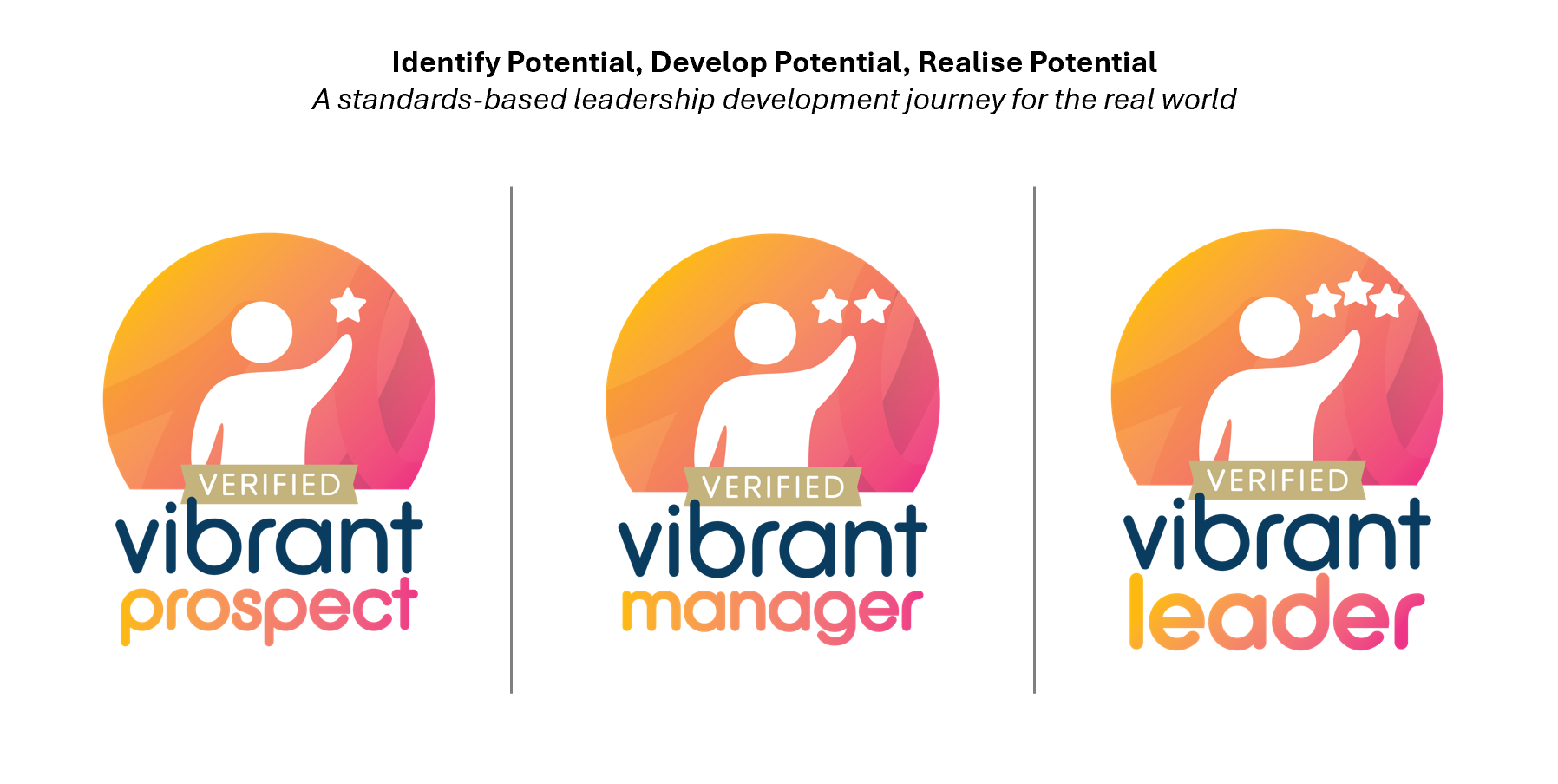
Each level will have an accreditation, but as with our Vibrant Workplace accreditation – it’s not a participation trophy.
It’s not a guarantee. It’s a standard. And it’s earned.
There needs to be skin in the game for people to focus and apply themselves.
A guaranteed badge doesn’t do that.
The Vibrant Leaders Pathway
The model we’re exploring has three stages:
Vibrant Prospects
For high-potential employees considering people leadership.
Before promotion, participants explore what leadership really involves and answer two important questions:
- Do I want to be a people leader?
Do I have the potential to be one?
Companies gain a clearer view of who should step into management roles – and who shouldn’t.
Vibrant Managers
For those already responsible for leading others.
This level focuses on building competence across the employee lifecycle and ensuring managers know what good leadership actually looks like in practice.
It begins and ends with a 360 survey so development is grounded in real feedback.
Vibrant Leaders
For seasoned leaders.
Too much leadership development prepares people for calm seas.
This level prepares leaders for when things get difficult – when the pressure is high and the answers aren’t obvious.
It’s the black belt of leadership development.
An Invitation to Co-Creating the Vibrant Leaders Pathway
I purposely don’t want to be too prescriptive at this stage – because too often these things are shaped in ‘the safety of the lab’. And that’s why they don’t work.
The methodology and delivery mechanism will likely:
- Combine group masterclasses with 1:1 personalised coaching.
- Be available in person or online, on a public course or closed course basis.
- Ensure application and competence is evidenced before accreditation.
- And participants will be able to join and leave the pathway at the levels which are right for them. For example, a current manager will not need to start at Prospect.
But I want to engage with you, understand what you would want and need from each level (whether it’s for yourself or your colleagues) and then use those insights to shape the final model meaning you have something that meets the needs of and solves the leadership challenges in your company.
All I ask from you in return if you take part in the co-creation workshop is that you commit to booking one person on a pilot of level one (Vibrant Prospects) and one on level two (Vibrant Managers) of the programme afterwards.
We’ll work together in co-creation to shape a solution that comes in at what you feel is a reasonable budget and expenditure for developing Prospects and Managers.
There will be a maximum of 10 spaces on the pilot cohorts, members of the Vibrant Workplace Collective will receive priority booking and access a preferred rate.
If you / your company would like to be part of this, please drop an email to craig@vibranttalent.co.uk indicating:
- How many people you would like to attend the co-creation event – this will take place in-person in March with approximate duration 2.5 – 3 hours.
- Any dates in this window that won’t work for you
In closing I’ll leave you with this, it’s a poll I saw on LinkedIn recently:
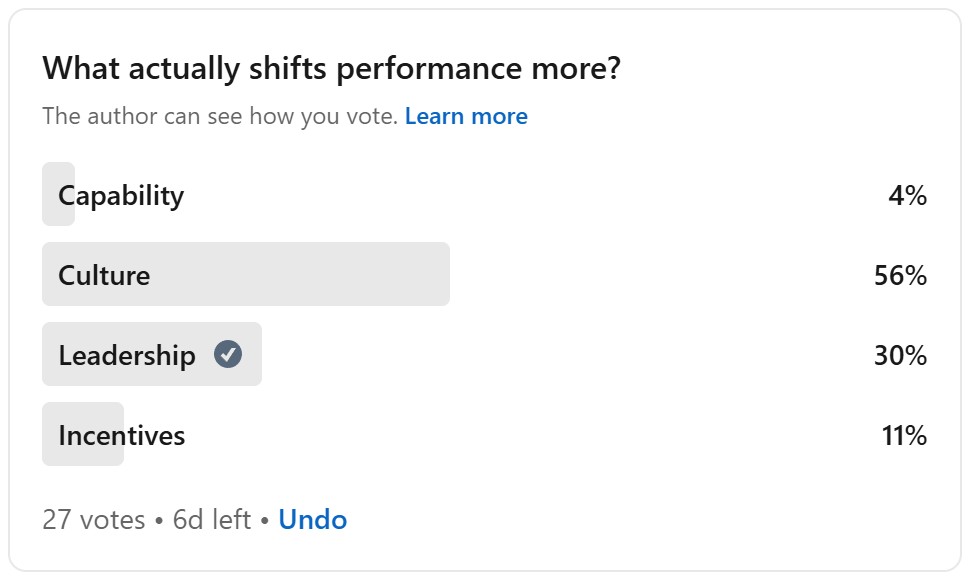
My reply was in the form of a classic overthinker…
“It’s a complicated one to answer Hayley, because it requires a bit of all of those…
- Capability is essential, but can be developed, and importantly – people need incentive to use it.
- Incentive is essential but needs to be more than extrinsic.
- Culture is essential as people take jobs and stay for money, but they engage and perform (rather than just pick up a paycheque) when they’re part of a vibrant culture.
- But a vibrant culture isn’t possible without leadership, no workplace can be great if the leaders don’t care for it to be so.
Without leadership you don’t get the right culture, incentives or capability building.
So I’d go leadership: compelling vision, actionable strategy, curated culture as the engine to power the execution of that strategy, Dan Pink style intrinsic incentivisation – with the right blend of extrinsic, talent ID and internal capability building.
It’s all of the above, but none of it happens without leadership.”
I’d love to know – what would you have said?
Thanks for reading,
Craig Thompson
Director, Vibrant